Back home to well-being
Liberating yourself from stress, anxiety, chronic pain or burnout
What if your body could unlock your wellbeing?
The innate regulation of our nervous system is sometimes stuck in activation because of overwhelm. The results is chronic stress, fatigue, anxiety, and so on. This impacts our heath, our perception of the world and puts us at risk of descending a downward spiral.
Not making progress with talk-therapy?
Talk therapy can sometimes explain your symptoms, but often your symptoms don't improve much. The symptoms and the mechanisms causing them are often purely physical, in the brain or in the body. They inaccessible to words and in those cases talk therapies are not sufficient.
It's not your fault
It is not only not in your head, it is also not your fault. Your defence systems have done the best they could to protect you. These are automatic, unconscious mechanisms, and it is not your fault. The defences were adaptive back then, stayed in that state and create issues today. When defences 'stick', you don't regulate properly. You don't get back to your calm state. There are ways to reactivate regulation. Keep reading.
Nervous system and emotional regulation
There may be more going on, but calming down your nervous system and your emotions is a good place to start. Both tools together are effective in re-establlishing a state of well-being when coming from a state of stress, anxiety or burnout.
A safe environment
We provide you a safe environment where you are listened to, your symptoms are acknowledged and in which you can learn, experiment and practice.
Regulating the nervous system
Everyone can get back to a normal regulation, even if defensive states have taken root since long, even when caused by trauma. Re-activating regulation starts with developing awareness, and is followed by simple science and evidence-based physical exercises.
There is no magic solution that works for everyone. The pathways to regulation are personal and each of us can (re)discover them. Therefore we propose a broad palette of approaches that have proven to cover the different needs of people. Whatever the approach,
-
You will better recognise and understand your internal states
-
You will sustainably regain well-being, rather than managing your stress.
-
Identify and integrate your own resources to stay in balance.
The more you will be in regulated states, the resilient you become, the longer the periods you are calm will become, and the more you will feel nourished by your relationships.
Emotional regulation
Emotional competences are complementary to nervous system regulation. They can be developed and improved for a better emotional regulation, more resilience. This helps building high-quality relationships, influencing and conflict resolution. You will different ways to upregulate positive emotions and regulate unpleasant emotions down. You will learn to
-
Develop savouring and gratitude to amplify positive emotions
-
Down regulating difficult emotions through breathing, displacement, developing insight into your triggers, and sharing to be heard
-
Developing your empathy and improve your relationships to benefit from social support
Supporting practices
Nervous system and emotional regulation have positive effects on blood pressure, immune function, inflammation, digestive function and comfort.
You can further support your journey with self-awareness, self-compassion, slow, conscious movement such as yoga, exercise, creativity, and quality nutrition, according to your preferences, needs and pace.
If implicit memories in the form of unexplained, or seemingly exaggerated emotions, or in the form of postures and movements play a role, these may require additional attention. We propose memory reconsolidating, implicit memory treatment, and parts work to transform and heal those memories.
Findings from medical studies
Simple awareness exercises of as little as five minutes a day have a measurable impact on anxiety and well-being.
Medical studies find that the nervous system regulation techniques we use significantly reduce hypertension, chronic inflammation (brain, coronaries gut), reduce food sensitivities and positively impact auto-immune diseases.
What clients say
-
After one week of doing exercises I am far less stressed and sleep better. Also my son is doing better. There is a clear before and after starting this work.
-
Calm and optimistic, Valentin has helped me getting rid of my anxiety and move on with my life.
-
I'm more connected with my body and I feel I have more control over my life..
-
Valentin's empathy has moved me and has helped me opening up to new techniques. I didn't expect these simple techniques would have a real impact so quickly.
-
I have learned how to manage my anxiety in a crisis.
-
It is a pleasure to be met as a human being where I am, without judgment.
If you want more in-depth information, we provide some below

Nervous system regulation
We are the best version of ourselves, when we feel safe, and we regulate ourselves together with others (coregulation). We tend to have more positive emotions, we recover and heal better, our brain is more capable of learning and innovation. The level of activation of the autonomous nervous system is within our window of tolerance
.
When we are activated by stress, anger or anxiety, and we come back quickly to a normal regulated state, this is normal and healthy. It is when activation becomes chronic, we become exhausted and we can develop burnout.
Another possible reaction to exhaustion may be an immobilised state, when we give up, withdraw or feel depressed. We also can arrive in this state when the stress was far to big to manage it as in traumatic events. The result is ‘shutdown’. Sometimes people oscillate between a depressed and an over activated state.
Knowing your states, discovering pathways back to safety and recovery, helps you finding back your energy, creativity and quality relationships.


Emotional regulation and intelligence
The nervous system reacts extremely fast to perceived changes in safety. It informs the brain that generates sensations in the body that we interpret as emotions. The brain will do a quick comparison with situations that caused similar states, and injects behaviour patterns and urges: wanting to leave, to be alone, to argue, to impress or to hide. There is a chance we react before thinking.
Only at this point we (can) become conscious of our state. We now build a story that matches the situation and our feelings, for example “it’s too much, I can’t cope” and we are tempted to follow the suggestion of the automatic brain. One can also apply free will, regulate oneself, and respond thoughtfully. The more we practice this, the easier it becomes.
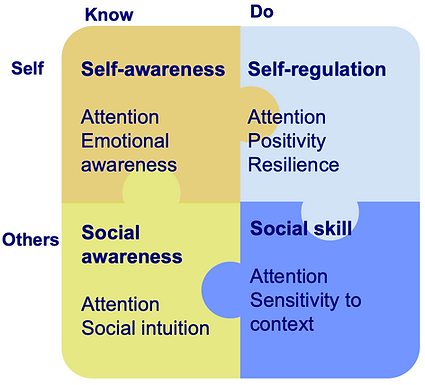
What we describe above is emotional regulation. It is built upon emotional self-awareness. Other emotional competencies have to do with emotions in relationships, such as empathy and social skill. All of these can be trained and improved.
The more we are capable of reacting with calm, distance and humour, the better we cope. Practicing emotional skills makes us more resilient, more calm and our relationships become more rewarding and nourishing.
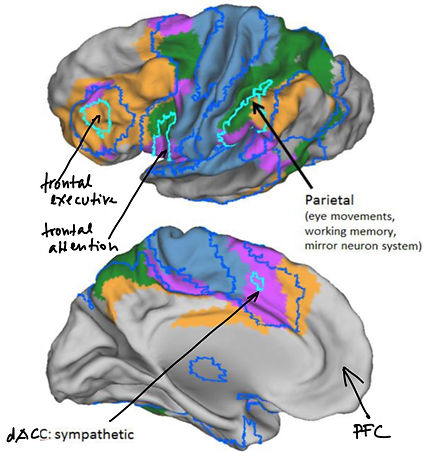
We use a simplified model of emotional intelligence that was derived from brain studies by Richard Davidson. It is simple to assess its aspects and to improve them.
The link between nervous system states, emotions and the brain
When someone tells you what to do, or puts you under pressure, or in any other stressful situation, the nervous system's defences kick in. The result is:
-
Rejection and anxiety
-
A narrow focus on the stressor
-
Prevention focus, advocacy
-
Stress, and quickly depleting energy
The adult thinking brain (prefrontal cortex, PFC) goes off-line. which means that social thinking becomes impossible. Learning, memorising, and creativity become become impaired.
When instead somebody offers you options to choose from we feel interested. If somone demonstrates care, we feel cared about. The nervous system relaxes:
-
Affiliation and interest
-
Widens perspective
-
Promotion focus
-
Renewal, builds energy
The adult brain is on-line and is capable of empathy, social thinking, creativity and learning. We feel good and we function well.

Why we need to regulate
Our inner world is not as simple as action needs to reaction. In the middle there is the nervous system as mediator, that primes us for specific emotions and flips the brain to states that influence our interpretation and our thinking.
The three states: regulated, activated (fight or flight) and immobilisation (giving up, depressed) each colour our interpretation of the world: for example the world is fundamentally a good place, the world is full of people trying to disadvantage me, or I don't care anymore.
In the regulated state we are capable of rational thinking as well as co-regulating with others for mutual support, while in the other states the world is more black and white.
In the regulated state our body and mind can recover and heal, while in the other two states we compromise our mental and physical health.
Although the activated and immobilised states keep us safe in accurate danger, and can be ver useful when blended with the regulated state, the chronically activated or immobilised states are to be avoided.
How we can regulate
The first thing is to get to know our nervous system and its state. Ideally we need to be aware of it from moment to moment.
Next we need to get to know ourselves and discover which conditions put is into which states. Then we can start preparing and protecting ourselves.
We also need to learn what can bring us back to a regulated state. Once we are activated, and are aware of it, we can apply these practices to calm ourselves down.
This is a somatic and simple approach. We can also analyse which our needs are that are threatened when we are activated, and which are needs are to calm down. These are often coupled with nervous system activation or immobilisation. Once we know our functioning, and we can catch ourselves reacting, we can also help ourselves to find the way back to harmony and well-being.
With simple exercises I help you discovering yourself and finding your pathways back to calms and well-being.